
Featuring Miglė Jakštaitė, PhD Student in Radboud University Nijmegen

We are delighted to highlight Miglė Jakštaitė’s activity within the CLASSY project. She is a PhD Student at Radboud University, Nijmegen and she has brought key contributions to the project by applying her knowledge to demonstrate how to perform cell-free biosynthesis in flow while having control of enzymatic reactions. In this short interview she shares some insights into her work and experience as a doctoral researcher working within the CLASSY research and innovation action.

How did you get into this field of research?

I have gained prior knowledge of enzyme kinetics during my internship in the group of Prof. Wilhelm T.S. Huck, where I later decided to continue my PhD programme. During my PhD I expanded my expertises of enzymatic synthesis, microfluidics and enzyme immobilisation. Now I use all these fields daily in my research for CLASSY project. 

Why did you apply for a researcher position with CLASSY?

I imagined it would be a great opportunity to closely collaborate with researchers from various groups within the consortium and that would result in many challenging projects. And I was right! Also having discussions and getting advices from other experts in the field is a highly valuable experience.

What is the most important quality you consider a researcher should have?

Curiosity – a quality which pushes you forward and doesn’t let you give up when you don’t get the results you were hoping for.

What is your favorite memory during CLASSY so far?

Our kick-off meeting in Zurich was quite memorable as we all met there for the first time and we could learn more about each other’s research interests. Also, filming CLASSY video in the labs was fun as well!

What are your aspirations for your research? (explain what you would like to do after your PhD)

After my PhD I would like to apply my knowledge in industry where hopefully I could continue working on enzymatic reactions.

Let’s leave science aside, what other hobbies do you have?

Dancing, hiking and dog walking!
HIGHLIGHTS ON THE CLASSY INDUSTRY WORKSHOP: BRINGING BIOCATALYSTS TO MICROREACTORS IN FLOW

The CLASSY Industry Workshop was held online on Monday, 16 October 2023, attracting 70 participants from the industry and academia. The event, titled “Bioreactions in flow reactors: bringing out the potential applications for cell-free synthetic biology”, zoomed in on the hot topic of cell-free enzymatic pathways in flow through eight talks by ten experts in the field.

Guided by Prof. Wolfgang Kroutil (Universität Graz), the CLASSY partners and scientists in systems chemistry showcased the latest results of the project: Prof. Wilhelm Huck (Radboud University Nijmegen) kicked off with a talk titled “Optimal experimental design strategies for optimising immobilized enzymatic reaction networks”. Subsequently, Dr. Christoph K. Winkler (Universität Graz) showcased the challenges with light and enzymes in flow; and Dr. Elwin Vrouwe (Micronit) ended the project research results with the layout of a general-purpose perfusable microfluidic reactor array.

Giving way to the six guest industry experts in the field of biocatalysis who raised the presentations towards the industry: Dr. David Roura Padrosa (inSEIT Biotech), Dr. Mattia Lazzarotto and Dr. Stefan Payer (Enzyan Biocatalysis), Dr. Rob Schoevaart (ChiralVision), Dr.Javier Ibáñez (EnginZyme) and Dr. David Liese (Enzymicals), showcased their latest research on the topic and actively answered to all the questions from the attendees. To foster the knowledge exchange between the academic sector and industrial R&D departments, each presentation was followed by a dedicated Q&A session. The workshop ended with an interesting panel discussion with all the speakers, led by Prof. Wolfgang Kroutil and Prof. Wilhelm Huck, concerning the potential applications of the Innovations in the industry.

All these excellent lectures are highlighted in the workshop recording and come up with the fact that applying all these innovations into the industry will accelerate the development greately. The speakers pointed out that all of them will keep on pushing the flow chemistry and the enzymes (either in cascades or batch) to have more showcases from which all can learn and improve further for the future industrial applications of cell-free synthetic biology.

Did you miss (parts of) the event or want to know more than these key takeaways from the workshop? You can also watch the full video on the CLASSY YouTube channel.

CLASSY holds its 10th General Assembly in Graz

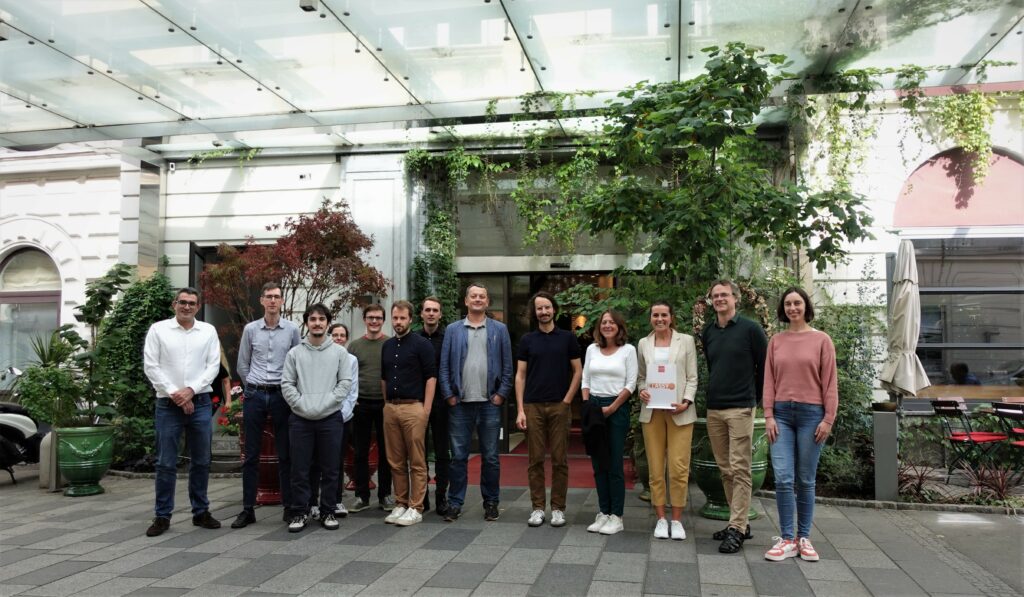
The 10th General Assembly meeting, hosted by the Graz University, took place in Graz on the 10-11th of October 2023. The meeting brought together 15 participants from all partners to discuss the progress towards the development of a new type of chemical reactor inspired by the way in which living systems manage to modulate catalytic activity.

The CLASSY partners pictured at the 10th General Assembly in October 2023 at Graz

Prof. Wolfgang Kroutil, Dr. Christoph K. Winkler, Dr. Mathias Pickl and Mr. Stefan Simic from University of Graz (UG) opened the meeting, welcoming all partners. To start with the programme of Day 1, Dr. Jeanette Muller (accelCH) presented the overall status of the project, leading a discussion between partners on how to address the next steps for research avenues to ensure the project’s progress until it’s final stage.

The rest of the morning was fully dedicated to research updates from all scientific work packages, starting with presentations from Prof. Gonen Ashkenasy (BGU), who presented his group’s progress on nucleic-acid-peptide chimeras and nucleopeptide replication networks, that were also released in two recent publications (Soft Matter, 2023, 19, 1940 and Cell Reports Physical Sciences, 2023, 4, 101594). Prof. Bartosz Lewandowski (ETH) contributed showing their collaboration with UAM, on the self-assembly and catalytic properties of peptide-nucleolipids and with BGU, on the recently started self-replicating assemblies for catalysis reactions. Still in showcasing their most recent publications, Prof. Andrés de la Escosura and Mr. Alonso Puente (UAM) made an update on the Syschem group’s latest progress including preliminary results in achieving controlled molecular assembly-disassembly with new techniques and informed that three papers will be published soon.

After the lunch break, Dr. Mathias Pickl and Mr. Stefan Simic (UG) presented and discussed their progress in bio- and organo-catalysis, followed by the intervention of Dr. Jonas Rackl (ETH), who presented their progress and new research avenues in chemoenzymatic cascade reactions. Subsequently, Ms. Miglė Jakštaitė and Wilhelm Huck (RU) presented their computational and lab-based approaches to cascade reactions, leading into an update on the latest microfluidic device prototypes by Elwin Vrouwe (MICRONIT). All these research progresses and collaboration highlights are available in the recently released joint CLASSY’s science slams video.

The consortium finished the first day full of presentations with several scientific discussion groups for more in-depth exchange between partners. Afterwards, an interactive brainstorming and discussion session on the project’s exploitation opportunities, led by Dr. Jeanette Muller and Ms. Miriam Frances (accelCH), was arranged with updated insights to be compiled in the innovation management system and lay the path for the upcoming exploitation activities, planned for the end of the project. The productive catch-up finished with a wrap-up on the upcoming CLASSY Industry Workshop that will take place on 16th October 2023 and with new ideas for upcoming conference participations and possibilities for the final CLASSY Scientific Symposium 2024.

On Day 2, all the partners had the chance to attend a guided lab tour through the laboratory facilities at the University of Graz, guided by Mr. Stefan Simic, gathering a better feel and understanding of how the Biocatalysis Research Group keep science in motion.